


실험자 배경
후니다 킴은 인간의 삶 깊숙이 침투한 기술, 그리고 기술이 촉발하는 생태계의 변화에 주목해 왔다. 인간의 지각 능력과 감수성은 가속화되는 초기술 사회의 변화 속도를 따라가기 어렵고, 쏟아지는 방대한 정보를 온전히 감각하고 분석하기에도 역부족이다. 그럼에도 인간은 그 속도를 따라가려 하고, 그 속에서 깊이 없이 쌓이는 포만감 속에 끝없이 흔들린다. 이에 작가는 감각을 예민하게 하는 ‘환경 인지 장치’를 제작하여 인간에게 직·간접적으로 이식하는 작업을 이어오고 있다.
최근에는 이 실천을 ‘스웨이-어튜닝’(sway-attuning)1이라는 개념으로 발전시켰다. 기술이 감각뿐 아니라 사고의 조건 자체에 개입하는 초기술 시대에, 능동적으로 세계를 당기던 인간이 점차 당겨지는 존재로 전환되는 흔들림의 국면을 탐구한다. ‘스웨이-어튜닝’은 이 흔들림에 저항하거나 균형을 고정하려는 시도가 아니라, 그 안에서 감각을 조율하며 살아가는 방식을 묻는다. 기술과의 필연적 결합을 직시하는 이 작업은 포스트휴먼의 인식과 감수성의 변화를 끊임없는 질문으로 다룬다.
1. ‘스웨이-어튜닝’(sway-attuning)은 작가가 제안하는 감각윤리의 개념이다. 여기서 감각윤리란, 무엇을 감각하고 무엇을 흘려보낼 것인가에 관한 조율의 윤리를 뜻한다.
Hoonida Kim focuses on technologies that deeply penetrate the human ecosystem, along with the ecological transformations triggered by these technologies. Human perception and sensitivity struggle to keep up with the accelerating pace of change in a hyper-technological society, as well as to sense and analyze the overwhelming volume of information. Yet they strive to do so nonetheless, trembling within the depthless saturation that continues to accumulate. In response, Kim has developed what he calls “environmental perception apparatuses”—devices designed to heighten sensory acuity. His practice also involves a distinctive approach, implanting these apparatuses into the human body, both directly and indirectly.
More recently, this practice has evolved into the concept of “sway-attuning,”1 through which the artist explores a state of oscillation in the era of hyper-technology, where technology intervenes not only in perception but in the very conditions of thought itself. Humans, once active agents who pulled the world toward them, are gradually shifting into beings that are pulled instead. Sway-attuning does not seek to resist this oscillation or fix an equilibrium; rather, it asks how one might survive by adjusting the senses. In this unflinching confrontation with the inevitable entanglement of technology and the human, Kim’s work engages with the reconfigured modes of perception and sensory experience characteristic of the posthuman condition, favoring continuous questioning over complete understanding.
1. Sway-attuning is the artist’s proposed concept of sensory ethics, which refers to an ethics of attunement concerning what to sense versus what to filter out.
실험 기록
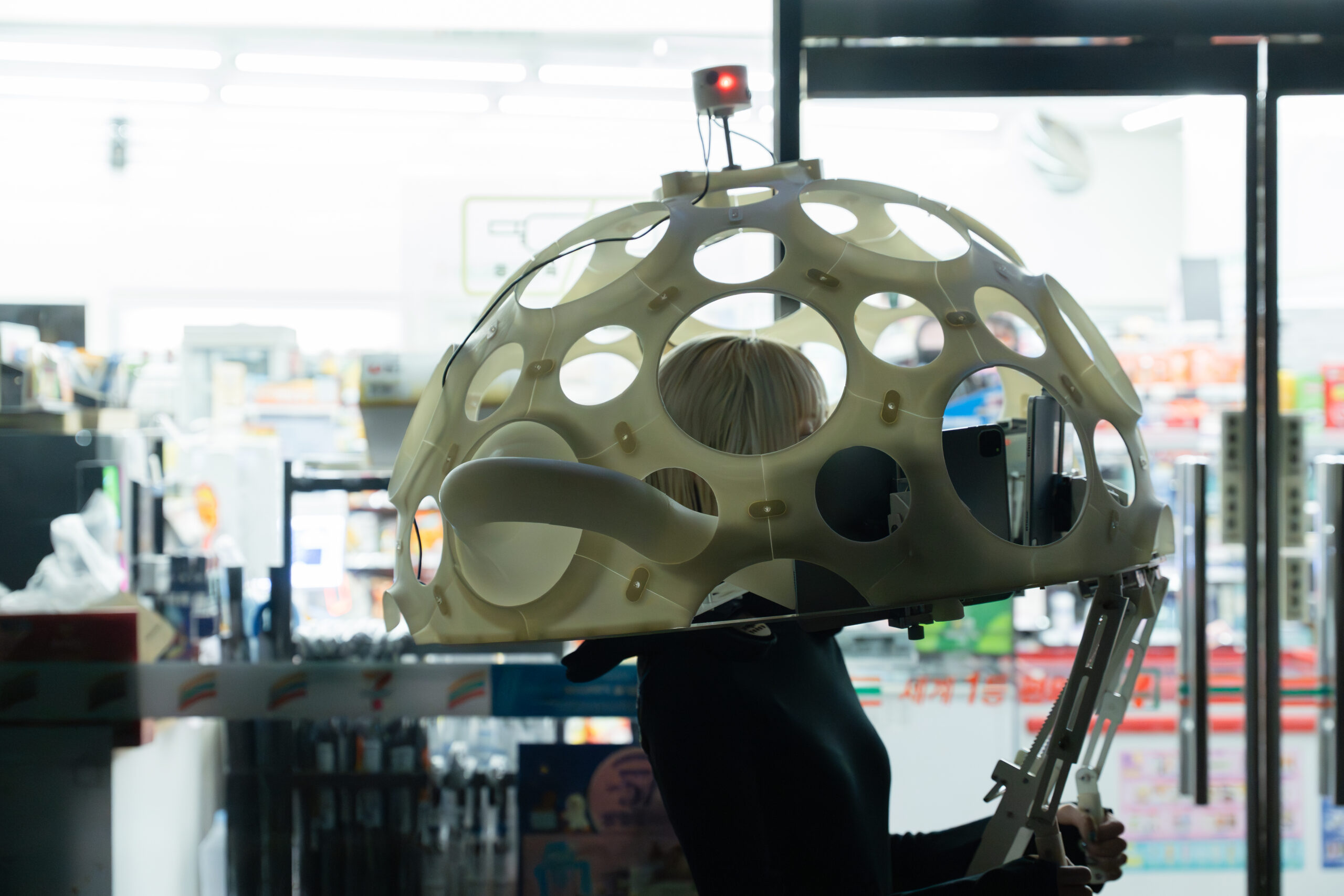
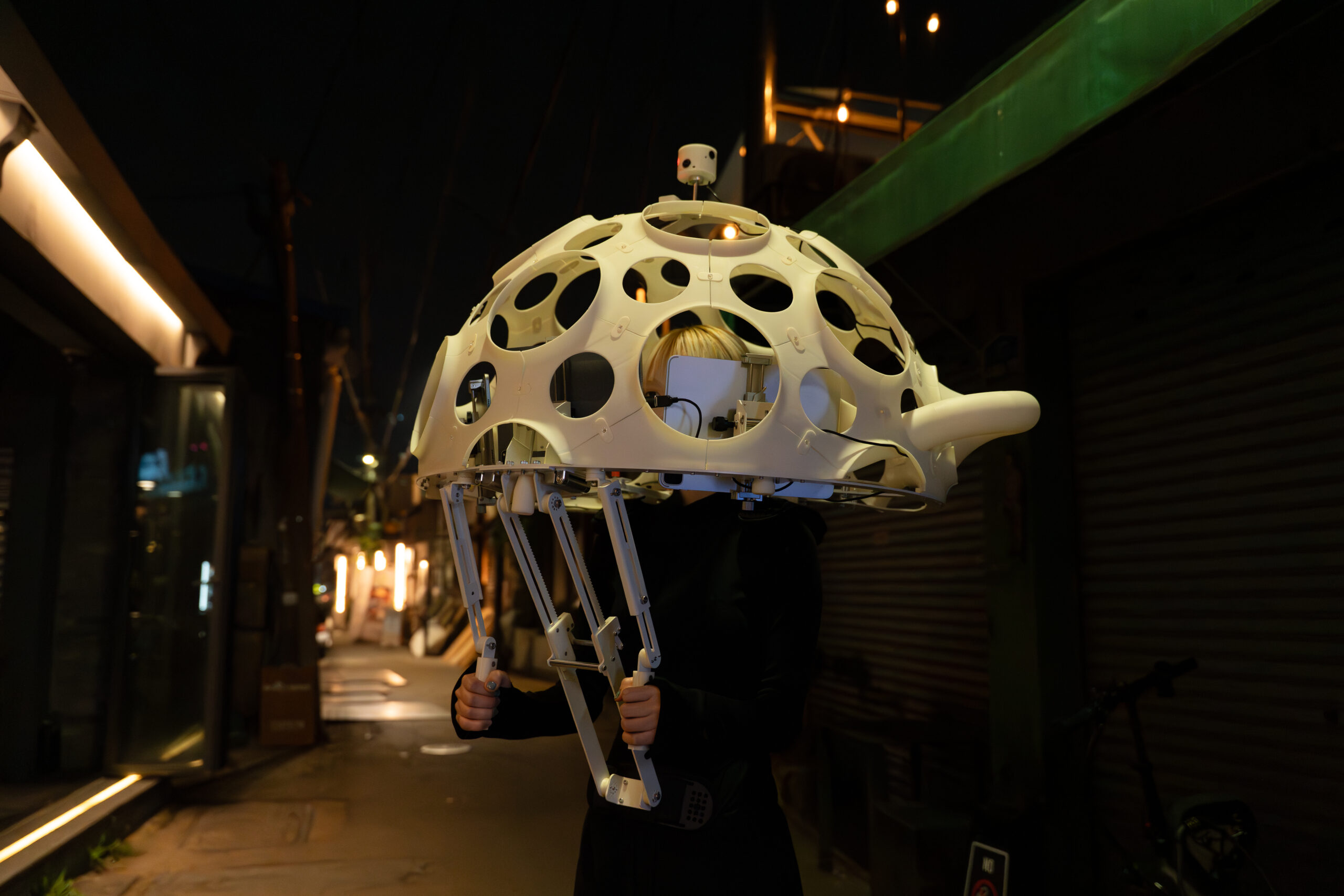
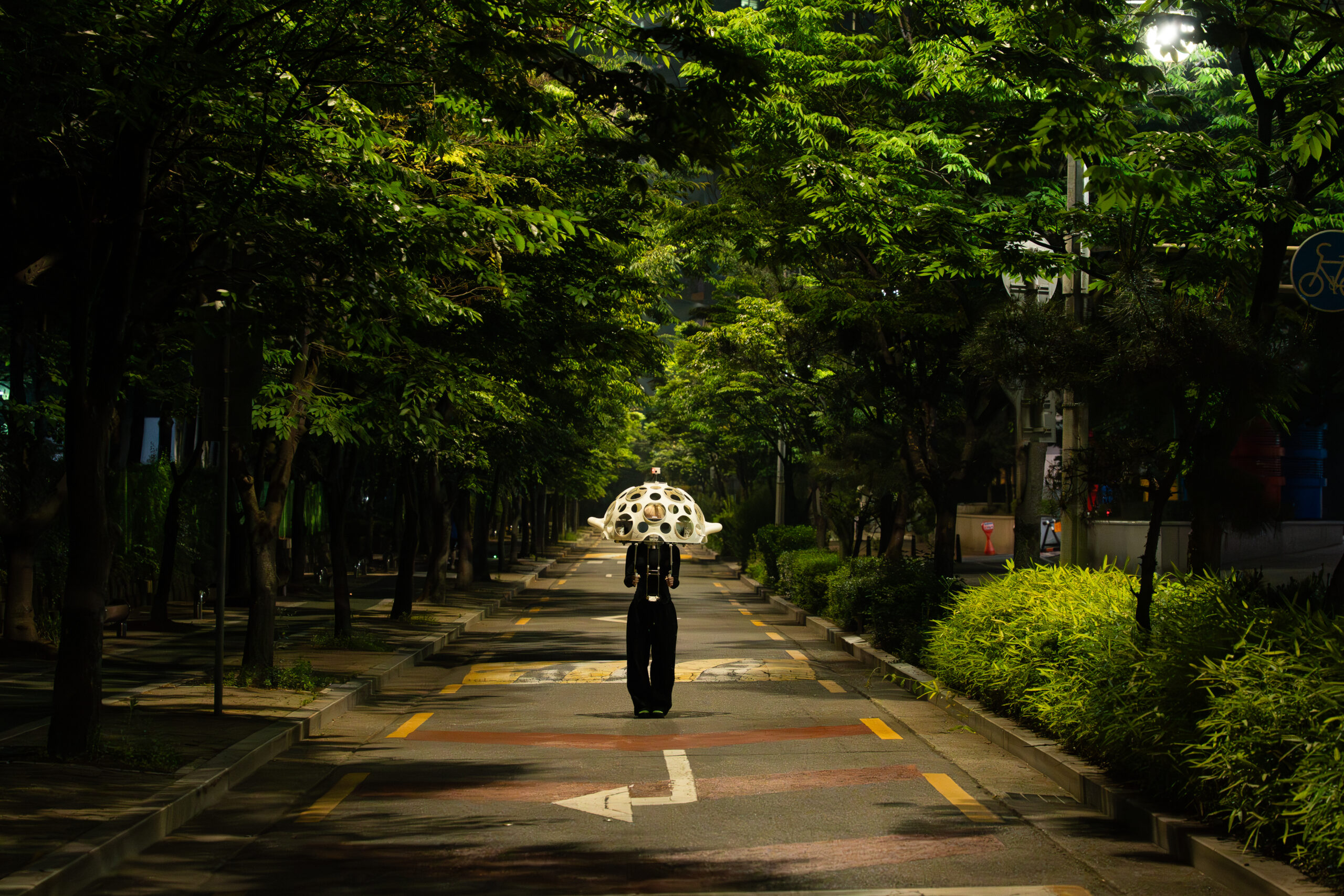
파인–튜닝 트레이닝 룸에서 선보이는 〈파인–튜닝되는 신체감각 2.1〉과 〈소마 패치 0.5〉는 관객이 ‘환경 인지 장치’를 보철로 직접 착용하고 연결하여 대상을 낯선 감각과 인식의 차원에서 경험하게 하는 실험이다.
실험 원리
인간의 눈은 중심을 응시하며 대상을 인식하지만, 곤충의 겹눈은 수백 개의 낱눈으로 전체를 동시에 감지한다. 해상도는 낮지만 시야각은 거의 360도에 이른다. 전체를 보되 아무것도 선명하게 보지 못하는 시각의 구조에 착안하여 디지털 장치를 인간의 신체에 일시적으로 이식한다.
이 장치를 착용하면 공간의 윤곽은 감지되지만, 개별 대상의 세부는 흐릿한 노이즈 상태로 남는다. 대상을 더 명확히 인식하려면 멈추어 서야 하며, 그 과정에는 눈에 가해지는 일정한 부담이 따른다. 그것을 견딜수록 이미지의 해상도가 높아지고, 사운드도 비정형의 노이즈에서 구체적인 음향으로 변화한다. 동시에 AI는 카메라의 시야가 닿지 않는 암흑 영역의 대상들을 언어로 생성한다. 관객이 아직 보지 못한 대상을 은유적 언어로 먼저 묘사함으로써, 그 언어를 통해 대상에 다가가게 만드는 접근이다.
〈소마 패치 0.5〉는 이물감을 몸의 이동으로 확장한다. 와이어로 화면과 연결된 착용자는 화면에 가까이 다가갈수록 장력이 줄고, 멀어질수록 저항을 느낀다. 쏟아지는 입력에서 거리를 두고 바라보는 것이 얼마나 어려운지를 몸이 감각한다. 와이어는 그동안 마찰 없이 습득해 온 정보에 미세한 저항을 되돌려준다.
관찰 소견
인간의 눈과 귀, 카메라, AI—이 모든 매체는 저마다의 방식으로 환경을 읽어낸다. 기술 덕분에 우리는 더 멀리, 더 넓게 감각할 수 있게 되었다. 그러나 그 감각이 마찰 없이 도착할수록, 우리는 직접 닿고 있다고 착각하기 쉬워진다. 〈파인–튜닝되는 신체감각 2.1〉은 보는 것에, 〈소마 패치 0.5〉는 움직이는 것에 이물감을 심는다. 그러나 이 장치들은 감각을 강화하거나 교정하려는 목적이 아니다. 기술과 신체 사이에 생긴 간극을 봉합하지 않고, 그 간극 안에서 감각하고 다시 인지하는 트레이닝을 제안한다.
Experiment Note
Presented in Hoonida Kim’s Fine-Tuning Training Room, Fine-Tuning Human Sense 2.1 and Soma Patch 0.5 are experiments that invite visitors to wear, connect to, and utilize prosthetic environmental perception apparatus, offering alternative modes of sensing and perception.
Principle
The human eye fixes upon a center, recognizing entities in relation to it, whereas the compound eye of an insect apprehends the whole at once through hundreds of individual lenses. Its resolution is low, yet its field of vision extends to nearly 360 degrees. It is a mode of seeing that perceives everything, and yet nothing with clarity. Taking this structure as a motif, the artist temporarily “implants” a digital apparatus into the human body.
When worn, the contours of space become perceptible, while the details of individual forms dissolve into blurred noise. To perceive something more distinctly, one must come to a halt and submit the eyes to a slight strain. The longer this strain is sustained, the higher the resolution of the image becomes; sound, too, gradually resolves from amorphous noise into discernible audio. At the same time, an AI generates textual imagery of entities that remain in dark zones beyond the reach of camera vision. This is not, however, an accurate prediction. Rather, by describing such unseen entities in metaphorical language, it offers a mediated approach, guiding the viewer toward them through language.
Soma Patch 0.5 extends this sense of estrangement into corporeal movement. The visitor’s body, connected to the screen by a wire, experiences less tension as it moves closer to the screen, and greater resistance as it moves away. It is not easy to maintain distance from the flood of incoming input; the body knows this. The wire returns a subtle resistance to information that has been acquired without friction.
Observation Note
The human eye and ear, the camera, and AI: each of these media reads the environment in its own way. Through technology, we have come to sense farther and more expansively. Yet the more effortlessly these sensations arrive, the more easily we are led to believe that we are in direct contact. Fine-Tuning Training Room inserts a sense of incongruity into this seamlessness: Fine-Tuning Human Sense 2.1 in sight, and Soma Patch 0.5 in movement. These apparatuses are not intended to enhance or correct perception. Rather than sealing the gap that has emerged between technology and the body, they propose a form of training, one that takes place within that gap, wherein sensing and perceiving are reengaged. Hoonida Kim’s work adopts a position of neither refusal nor compliance, asking instead how we might attune ourselves within this state of oscillation.

실험일지 작성하기
Writing Experiment Log

copyright 2026
by Busan Museum of Contemporary Art All rights reserved.
담당자. 김소슬
부산광역시 사하구
낙동남로 1191
(하단동)부산현대미술관
051-220-7400
